Recent Advances in 2D Photonic Materials: A Review of Optical Properties and Integration Challenges
DOI:
https://doi.org/10.53655/joe.m5151dKeywords:
2D materials, Integrated photonics, van der Waals heterostructuresAbstract
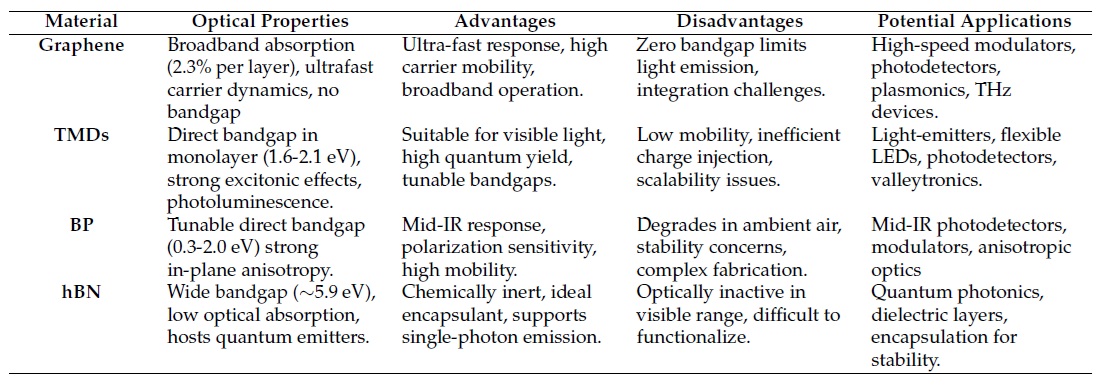
Two-dimensional (2D) materials are emerging in photonics due to their atomic-scale thick nature, strong interaction with light, and diverse electronic characteristics. This review explores the use of 2D materials like graphene, TMDs, BP, and hBN, focusing on their roles in high-speed modulation, photodetectors, and creating flexible, adjustable light sources. We compare their optical properties and examine their suitability for advanced photonic technologies. Material synthesis, such as wafer-scale growth and van der Waals stacking, have significantly improved their compatibility with integrated photonic platforms. However, there are critical challenges that need to deal with, such scalability, environmental stability, CMOS compatibility. Material encapsulation techniques, producing large-area growth methods, and interface engineering are being actively pursued to overcome these limitations. This review summarizes current progress and ongoing challenges in the field.
References
F. Pang et al., “Progress and Perspectives in 2D Piezoelectric Materials for Piezotronics and Piezo-Phototronics,” Advanced Science, vol. 12, no. 24, Mar. 2025, ISSN: 2198-3844. DOI: 10.1002/advs.202411422
A. Reserbat-Plantey et al., “Quantum Nanophotonics in Two-Dimensional Materials,” ACS Photonics, vol. 8, no. 1, pp. 85–101, Jan. 2021, ISSN: 2330-4022. DOI: 10.1021/acsphotonics.0c01224
R. S. Lodhi and P. Das, “Preparation of Self-Assembled Sodium Carboxymethylcellulose/Polydopamine-Modified Cellulose Nanocrystals Ternary Nanocomposites: Implications for High-Performance UV-Shielding Films,” ACS Applied Nano Materials, vol. 6, no. 1, pp. 431–444, Dec. 2022, ISSN: 2574-0970. DOI: 10.1021/acsanm.2c04557
X. Liang et al., “Van der waals integrated LiNbO3/WS2 for high-performance UV-Vis-NIR photodetection,” Laser & Photonics Reviews, vol. 17, no. 10, Jul. 2023, ISSN: 1863-8899. DOI: 10.1002/lpor.202300286
Downloads
Published
How to Cite
Issue
Section
License
Copyright (c) 2025 Woan Wen Tan, Naveen Palanichamy, C. Palanichamy

This work is licensed under a Creative Commons Attribution-NonCommercial 4.0 International License.
By submitting documents to Jurnal OptoElektronik, the authors agree to the followings:
1. Articles are published under a Creative Commons CC BY-NC 4.0 license that allows third parties to read, download, copy and share their work provided proper acknowledgement are given.
2. The authors retain copyright and grant Jurnal OptoElektronik rights of first publication.
3. The authors are permitted and encouraged to share their work online (e.g., in institutional repositories or on their website)
4. The authors verifies that the submission has not been previously published, nor is it before another journal for consideration. If submitting an article for resubmission, the submitting author will need to notify the editor through the Comments for the Editor section in the submission process.
5. The authors are responsible to secure all necessary copyright permissions for the use of 3rd-party materials in their manuscript.
6. The author declares that this is their original work and has been written by the stated authors.