Improve Formaldehyde Vapor Sensing
DOI:
https://doi.org/10.53655/joe.u9646mKeywords:
Tapered optical fiber, Formaldehyde, Rhenium Disulfide, sensitivityAbstract
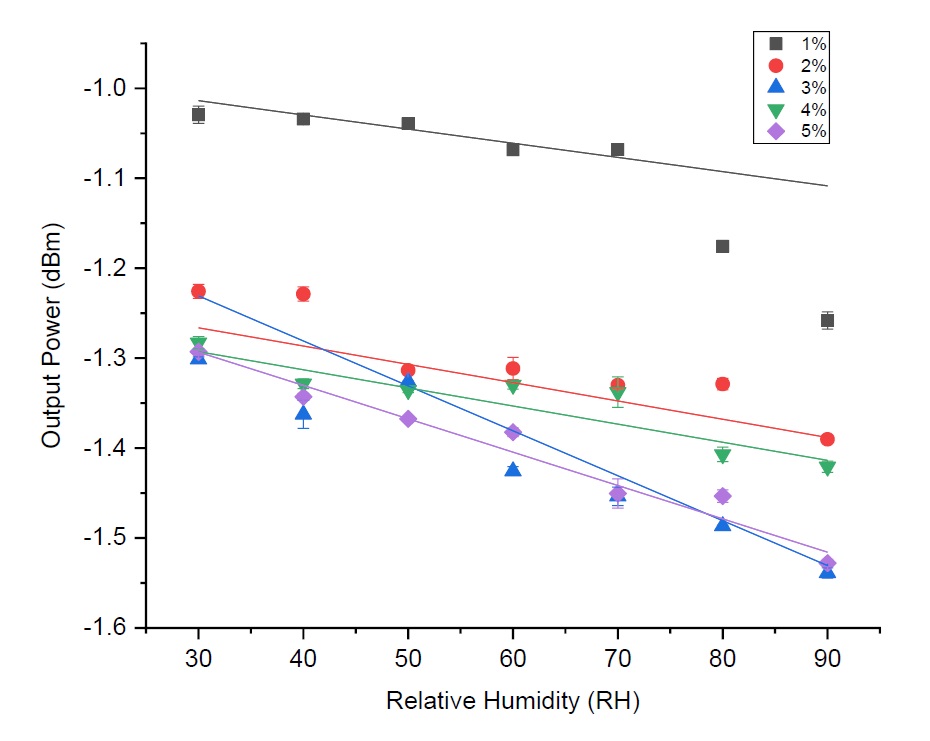
Formaldehyde (CH₂O) is a toxic, colourless, and flammable gas that is widely used in various industries and household products. Current formaldehyde detection methods often suffer from limitations such as low sensitivity, high cost, and impracticality for widespread use in residential and industrial settings. This study focuses on evaluating the performance of uncoated and Rhenium Disulfide (ReS₂)-coated tapered optical fibers (TOFs) in detecting formaldehyde, using fibers with a waist diameter of 10 µm and a length of 3 mm. The experimental evaluation was conducted by exposing the TOFs to formaldehyde vapor concentrations of 1%, 2%, 3%, 4%, and 5%, under relative humidity conditions ranging from 30% to 90%. The results show that the ReS₂-coated TOFs demonstrated better sensitivity in detecting formaldehyde compared to uncoated TOFs with measured sensitivities of –0.03245 dBm/% and –0.00371 dBm/% at 5% formaldehyde concentration. Overall, formaldehyde sensing performance can be improved by coating the TOFs with ReS₂, with sensitivity increasing by more than 80% compared to the uncoated fibers.
References
S. Aftab et al., “ReSe2/metal interface for hydrogen gas sensing,” Journal of Colloid and Interface Science, vol. 603, pp. 511–517, Dec. 2021, ISSN: 0021-9797. DOI: 10.1016/j.jcis.2021.06.117
S. H. Johari et al., “Formaldehyde Sensing Using Tapered U-Shape Plastic Optical Fiber Coated With Zinc Oxide Nanorods,” IEEE Access, vol. 10, pp. 91 445–91 451, 2022, ISSN: 2169-3536. DOI: 10.1109/access.2022.3202176
N. Burham, N. Ali, M. A. A. Mazlan, M. R. A. Rizal, A. H. Awang, and N. Arsad, “Optimization of tapered microfiber humidity sensors with molybdenum disulfide coating,” International Journal of Nanoelectronics and Materials (IJNeaM), vol. 18, no. 2, pp. 230–235, May 2025, ISSN: 1985-5761. DOI: 10.58915/ijneam.v18i2.2121
Downloads
Published
How to Cite
Issue
Section
License
Copyright (c) 2025 NORHAFIZAH BURHAM, NAIMAH MAT ISA, AZIATI BINTI AWANG, Amir Syazwan Tukiman

This work is licensed under a Creative Commons Attribution-NonCommercial 4.0 International License.
By submitting documents to Jurnal OptoElektronik, the authors agree to the followings:
1. Articles are published under a Creative Commons CC BY-NC 4.0 license that allows third parties to read, download, copy and share their work provided proper acknowledgement are given.
2. The authors retain copyright and grant Jurnal OptoElektronik rights of first publication.
3. The authors are permitted and encouraged to share their work online (e.g., in institutional repositories or on their website)
4. The authors verifies that the submission has not been previously published, nor is it before another journal for consideration. If submitting an article for resubmission, the submitting author will need to notify the editor through the Comments for the Editor section in the submission process.
5. The authors are responsible to secure all necessary copyright permissions for the use of 3rd-party materials in their manuscript.
6. The author declares that this is their original work and has been written by the stated authors.