Relative Humidity Sensor using Tungsten Disulfide Coated on Tapered Microfiber
DOI:
https://doi.org/10.53655/joe.s3858hKeywords:
WS2 coating, Humidity Sensing, Tapered Fiber, Flame Brushing TechniqueAbstract
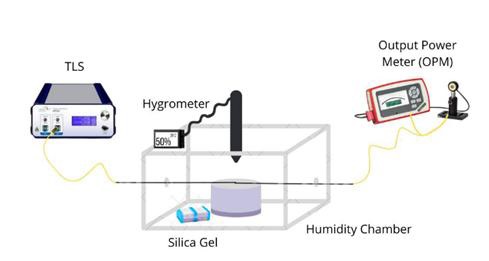
A two-dimensional transition-metal dichalcogenide material like tungsten disulfide (WS2) can be used to increase the sensitivity of a few sensing applications. The impact of WS2 coating on tapered region microfiber (MF) for relative humidity (RH) sensing applications was examined in this work. The typical single-mode fiber (SMF) and waist diameter diameters of Microfiber 3 µm were tapered, using the flame brushing technique. The drop-casting process, a simple deposition technique, was then used to coat the microfiber in WS2. Depositing WS2 onto the tapered zone resulted in high humidity sensor sensitivity because the MF had a strong evanescent field that enabled quick near-field interaction between the directed light and the environment. To demonstrate repeatability and sensor stability, the experiments were repeated three times to quantify the average transmitted power. Different %RH concentration was evaluated with the MF sample size. Additionally, at room temperature and in the %RH range of 40% to 60% RH, the performances of coated and uncoated microfiber were examined. Thus, microfiber coated with WS2 encourages enhancement in the evanescent field effect in optical fiber humidity sensor.
References
N. Burham, N. Ali, M. A. A. Mazlan, M. R. A. Rizal, A. H. Awang, and N. Arsad, “Optimization of tapered microfiber humidity sensors with molybdenum disulfide coating,” International Journal of Nanoelectronics and Materials (IJNeaM), vol. 18, no. 2, pp. 230–235, May 2025, ISSN: 1985-5761. DOI: 10.58915/ijneam.v18i2.2121
Y. Tang, Q. Zhang, X. Dong, and C. C. Chan, “Cu2+ detecting by using optical fiber Mach-Zehnder interferometer coated with CS/PAA,” in 2021 19th International Conference on Optical Communications and Networks (ICOCN), IEEE, Aug. 2021, pp. 1–3. DOI: 10.1109/icocn53177.2021.9563688
C. Bian, J. Wang, X. Bai, M. Hu, and T. Gang, “Optical fiber based on humidity sensor with improved sensitivity for monitoring applications,” Optics & Laser Technology, vol. 130, p. 106 342, Oct. 2020, ISSN: 0030-3992. DOI: 10.1016/j.optlastec.2020.106342
N. Ali et al., “Effects of tungsten disulphide coating on tapered microfiber for relative humidity sensing applications,” Sensors, vol. 21, no. 21, p. 7132, Oct. 2021, ISSN: 1424-8220. DOI: 10.3390/s21217132
H. Yang et al., “High-sensitivity tapered fiber relative humidity sensor based on PDMS and GO films,” Optical Materials Express, vol. 14, no. 3, p. 725, Feb. 2024, ISSN: 2159-3930. DOI: 10.1364/ome.519037
Downloads
Published
How to Cite
Issue
Section
License
Copyright (c) 2025 Naimah Mat Isa, Muhammad Razin Aiman Rizal, Aziati Husna Awang, Norhafizah Burham

This work is licensed under a Creative Commons Attribution-NonCommercial 4.0 International License.
By submitting documents to Jurnal OptoElektronik, the authors agree to the followings:
1. Articles are published under a Creative Commons CC BY-NC 4.0 license that allows third parties to read, download, copy and share their work provided proper acknowledgement are given.
2. The authors retain copyright and grant Jurnal OptoElektronik rights of first publication.
3. The authors are permitted and encouraged to share their work online (e.g., in institutional repositories or on their website)
4. The authors verifies that the submission has not been previously published, nor is it before another journal for consideration. If submitting an article for resubmission, the submitting author will need to notify the editor through the Comments for the Editor section in the submission process.
5. The authors are responsible to secure all necessary copyright permissions for the use of 3rd-party materials in their manuscript.
6. The author declares that this is their original work and has been written by the stated authors.