Data Fusion K-Means Clustering for Seismic Signal Classification Using Integrated DAS-Geophone Sensing
DOI:
https://doi.org/10.53655/joe.d8752tKeywords:
Distributed Acoustic Sensing (DAS), Geophone, Data Fusion, SeismicAbstract
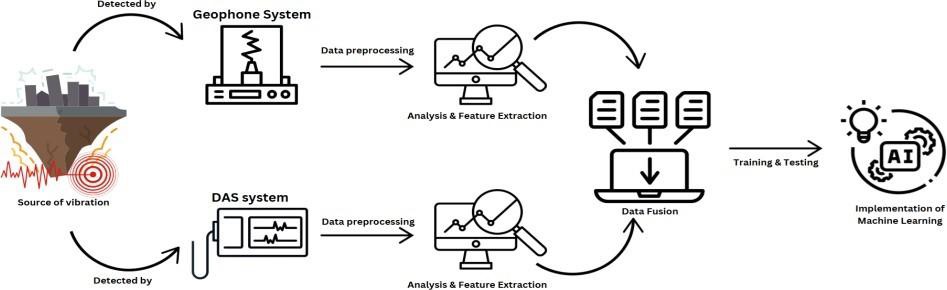
Distributed Acoustic Sensing (DAS) and geophone technologies are implemented for seismic monitoring with a limited comparative analysis between these systems particularly in integrating data from heterogeneous sensors. One of raising inutilization of advanced machine learning for seismic data classification. Data fusion is promising solution, which capable of combining information from multiple sources to improve accuracy and robustness of seismic interpretation. Hence, in this study focus on integrating DAS and geophone data using data fusion by utilizing unsupervised machine learning with K-Means clustering to classify seismic signals. Seven clusters are used in this study which used PCA and t-SNE scatter plot for the K-Mean clustering, Results show that the proposed methodology demonstrates effectiveness in distinguishing between common and anomalous seismic events. Visualization and cluster analysis confirm the interpretability and practical value of this framework. From the findings, this study offers promising basis for anomaly detection and routine monitoring system with future works aimed at improving clustering techniques.
References
M. R. Fernández-Ruiz et al., “Distributed acoustic sensing for seismic activity monitoring,” APL Photonics, vol. 5, no. 3, Mar. 2020, ISSN: 2378-0967. DOI: 10.1063/1.5139602
K. Ma, J. Wu, Y. Ma, B. Xu, S. Qi, and X. Jiang, “An Effective Method for Improving Low-Frequency Response of Geophone,” Sensors, vol. 23, no. 6, p. 3082, Mar. 2023, ISSN: 1424-8220. DOI: 10.3390/s23063082
S. R. Chandran, H. Mohamad, M. Y. M. Nasir, M. F. Ghazali, M. A. Abdullah, and V. Epin, “A Comparative Study of Seismic Characteristics Between Distributed Acoustic Sensing (DAS) and Geophones,” in Advances in Civil Engineering Materials. Springer Nature Singapore, 2024, pp. 771–783, ISBN: 9789819707515. DOI: 10.1007/978-981-97-0751-5_66
H. Hartono, H. Anwar, R. Umam, and H. Takahashi, “An unsupervised machine learning algorithm approach using K-Means Clustering for optimizing Surface Wave Filtering in seismic reflection data,” Journal of Natural Sciences and Mathematics Research, vol. 10, no. 1, pp. 114–127, Jul. 2024, ISSN: 2614-6487. DOI: 10.21580/jnsmr.v10i1.22399
Downloads
Published
How to Cite
Issue
Section
License
Copyright (c) 2025 Long Muhammad Haziq Long Hassan, Norhana Arsad, Seri Mastura Mustaza

This work is licensed under a Creative Commons Attribution-NonCommercial 4.0 International License.
By submitting documents to Jurnal OptoElektronik, the authors agree to the followings:
1. Articles are published under a Creative Commons CC BY-NC 4.0 license that allows third parties to read, download, copy and share their work provided proper acknowledgement are given.
2. The authors retain copyright and grant Jurnal OptoElektronik rights of first publication.
3. The authors are permitted and encouraged to share their work online (e.g., in institutional repositories or on their website)
4. The authors verifies that the submission has not been previously published, nor is it before another journal for consideration. If submitting an article for resubmission, the submitting author will need to notify the editor through the Comments for the Editor section in the submission process.
5. The authors are responsible to secure all necessary copyright permissions for the use of 3rd-party materials in their manuscript.
6. The author declares that this is their original work and has been written by the stated authors.