Tunable Wide Dissipative Soliton Resonance Generation by Figure-of-Eight Nonlinear Amplifying Loop Mirror
DOI:
https://doi.org/10.53655/joe.e9812pKeywords:
Fiber Laser, Mode-locked, Figure-of-Eight, Nonlinear Amplifying Loop Mirror (NALM), Dissipative Soliton Resonance (DSR)Abstract
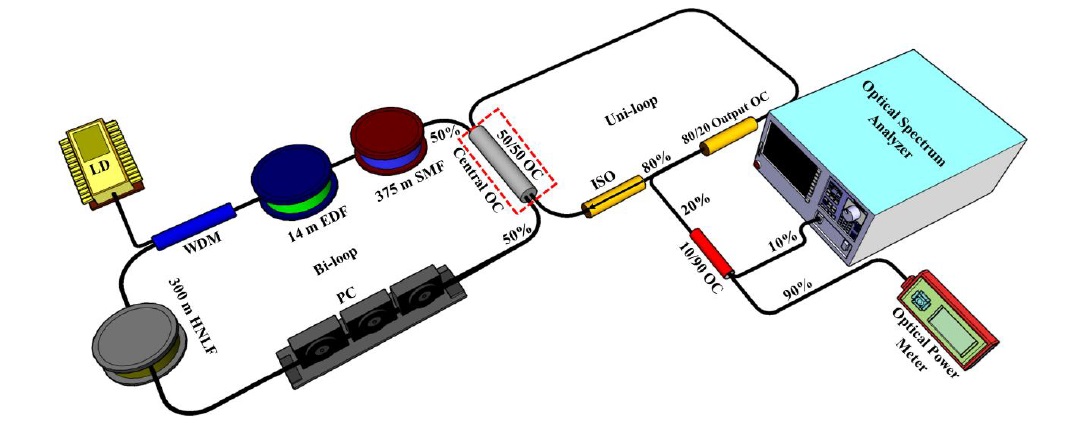
We demonstrate dissipative soliton resonance (DSR) mode-locking using a nonlinear amplifying loop mirror (NALM) in a C-band erbium-doped fiber (EDF) laser. The mode-locked laser achieved 3-dB spectral bandwidth of 24.56 nm centered at 1562.7 nm, with an output power of 5.0 mW and a pulse energy of 16.81 nJ. The DSR pulse tunability was optimized, where the pulse width was extended from 20 ns to 140 ns, demonstrating enhanced performance with a repetition rate of 297.3 KHz. The optimization was achieved through careful figure-of-eight NALM cavity design, precise polarization control and progressive pump power tuning under net anomalous dispersion
References
W. Chang, A. Ankiewicz, J. M. Soto-Crespo, and N. Akhmediev, “Dissipative soliton resonances,” Phys Rev A, vol. 78, no. 2, pp. 1–9, 2008, doi: 10.1103/PhysRevA.78.023830.
Y. Xu, Y. L. Song, G. G. Du, P. G. Yan, C. Y. Guo, G. L. Zheng, and S. C. Ruan, “Dissipative soliton resonance in a wavelength-tunable thulium-doped fiber laser with net-normal dispersion,” IEEE Photonics J, vol. 7, no. 3, 2015, doi: 10.1109/JPHOT.2015.2424855.
W. Du, H. Li, J. Li, P. Wang, S. Zhang, and Y. Liu, “Mechanism of dissipative-soliton-resonance generation in fiber laser mode-locked by real saturable absorber,” Opt Express, vol. 26, no. 16, p. 21314, 2018, doi: 10.1364/oe.26.021314.
Q. Sheng, S. Tang, F. Ye, Y. Wang, S. Chen, C. Bai, G. Wang, C. Lu, H. Zhang, X. Liu, and W. Zhang, “Generation of dissipative soliton resonance and soliton rain in passively mode-locked fiber laser based on GeTe saturable absorber,” Infrared Phys Technol, vol. 131, Jun. 2023, doi: 10.1016/j.infrared.2023.104675.
S.-K. Wang, Q.-Y. Ning, A.-P. Luo, Z.-B. Lin, Z.-C. Luo, and W.-C. Xu, “Dissipative soliton resonance in a passively mode-locked figure-eight fiber laser,” Opt Express, vol. 21, no. 2, p. 2402, 2013, doi: 10.1364/oe.21.002402.
G. Deng and T. Wang, “Investigation into Adjustable Dissipative Soliton Resonance Generation in Double-Pumped Figure Eight Cavity Using Nonlinear Amplifying Loop Mirror,” 2021 13th International Conference on Advanced Infocomm Technology, ICAIT 2021, no. 1, pp. 46–50, 2021, doi: 10.1109/ICAIT52638.2021.9701975.
Z.-C. Luo, Q.-Y. Ning, H.-L. Mo, H. Cui, J. Liu, L.-J. Wu, A.-P. Luo, and W.-C. Xu, “Vector dissipative soliton resonance in a fiber laser,” Opt Express, vol. 21, no. 8, p. 10199, 2013, doi: 10.1364/oe.21.010199.
D. Li, D. Tang, L. Zhao, and D. Shen, “Mechanism of Dissipative-Soliton-Resonance Generation in Passively Mode-Locked All-Normal-Dispersion Fiber Lasers,” Journal of Lightwave Technology, vol. 33, no. 18, pp. 3781–3787, Sept. 2015, doi: 10.1109/jlt.2015.2449874.
Downloads
Published
How to Cite
Issue
Section
License
Copyright (c) 2025 Zuraidah Zan, Hikmat, Norita Mohd Yusoff, Siti Barirah Ahmad Anas, Makhfudzah Mokhtar, Mohd Adzir Mahdi

This work is licensed under a Creative Commons Attribution-NonCommercial 4.0 International License.
By submitting documents to Jurnal OptoElektronik, the authors agree to the followings:
1. Articles are published under a Creative Commons CC BY-NC 4.0 license that allows third parties to read, download, copy and share their work provided proper acknowledgement are given.
2. The authors retain copyright and grant Jurnal OptoElektronik rights of first publication.
3. The authors are permitted and encouraged to share their work online (e.g., in institutional repositories or on their website)
4. The authors verifies that the submission has not been previously published, nor is it before another journal for consideration. If submitting an article for resubmission, the submitting author will need to notify the editor through the Comments for the Editor section in the submission process.
5. The authors are responsible to secure all necessary copyright permissions for the use of 3rd-party materials in their manuscript.
6. The author declares that this is their original work and has been written by the stated authors.