A Robust Brillouin Frequency Shift Extraction in BOTDR under Noisy condition Using AdaBoost Regression
DOI:
https://doi.org/10.53655/joe.k2451vKeywords:
Brillouin Frequency Shift (BFS), AdaBoost Regression, BOTDRAbstract
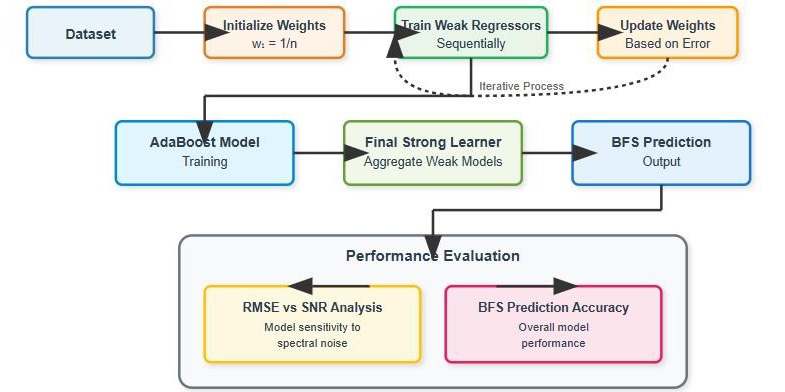
Accurate extraction of the Brillouin Frequency Shift (BFS) is vital for high-performance distributed fiber sensing, particularly under noisy or low-resolution conditions. This study presents a robust machine learning approach using the AdaBoost regression algorithm to extract BFS from Brillouin Gain Spectra (BGS) under challenging spectral scenarios, including low signal-to-noise ratio (SNR), limited frequency range, and coarse resolution. Experimental BGS data were obtained from a Differential-Cross Spectrum (DCS) BOTDR setup based on the correlation of two optical pulses, measured over a temperature range of 25°C to 70°C. To enhance model generalization, synthetic noisy datasets were generated through data augmentation, and Savitzky-Golay filtering was applied to preserve spectral peak structure. The results demonstrate the model’s robustness and highlight the importance of maintaining high SNR, sufficient frequency coverage, and fine resolution for reliable BFS extraction in practical sensing environments.
References
H.Wu, L.Wang, N. Guo, C. Shu, and C. Lu, “Brillouin Optical Time-Domain Analyzer Assisted by Support Vector Machine for Ultrafast Temperature Extraction,” Journal of Lightwave Technology, vol. 35, no. 19, pp. 4159–4167, Oct. 2017, ISSN: 1558-2213. DOI: 10.1109/jlt.2017.2739421
H. Zheng, F. Xiao, S. Sun, and Y. Qin, “Brillouin Frequency Shift Extraction Based on AdaBoost Algorithm,” Sensors, vol. 22, no. 9, p. 3354, Apr. 2022, ISSN: 1424-8220. DOI: 10.3390/s22093354
J. N. Caceres, K. Noda, G. Zhu, H. Lee, K. Nakamura, and Y. Mizuno, “Spatial resolution enhancement of brillouin optical correlation-domain reflectometry using convolutional neural network: Proof of concept,” IEEE Access, vol. 9, pp. 124 701–124 710, 2021, ISSN: 2169-3536. DOI: 10.1109/access.2021.3110874
Y. Chang, H.Wu, C. Zhao, L. Shen, S. Fu, and M. Tang, “Distributed brillouin frequency shift extraction via a convolutional neural network,” Photonics Research, vol. 8, no. 5, p. 690, Apr. 2020, ISSN: 2327-9125. DOI: 10.1364/prj.389970
C. Lu, Y. Liang, X. Jia, Y. Fu, J. Liang, and Z. Wang, “Artificial neural network for accurate retrieval of fiber brillouin frequency shift with non-local effects,” IEEE Sensors Journal, vol. 20, no. 15, pp. 8559–8569, Aug. 2020, ISSN: 2379-9153. DOI: 10.1109/jsen.2020.2985550
H. Zheng, “Extraction of brillouin frequency shift in brillouin distributed fiber sensors by neighbors-based machine learning,” in Advanced Sensor Systems and Applications X, G.-D. Peng and Z. He, Eds., SPIE, Oct. 2020, p. 15. DOI: 10.1117/12.2573346
Downloads
Published
How to Cite
Issue
Section
License
Copyright (c) 2025 Intan Fatimah Sasila Ghadzali, Ain Nabihah, Saiful Dzulkefly

This work is licensed under a Creative Commons Attribution-NonCommercial 4.0 International License.
By submitting documents to Jurnal OptoElektronik, the authors agree to the followings:
1. Articles are published under a Creative Commons CC BY-NC 4.0 license that allows third parties to read, download, copy and share their work provided proper acknowledgement are given.
2. The authors retain copyright and grant Jurnal OptoElektronik rights of first publication.
3. The authors are permitted and encouraged to share their work online (e.g., in institutional repositories or on their website)
4. The authors verifies that the submission has not been previously published, nor is it before another journal for consideration. If submitting an article for resubmission, the submitting author will need to notify the editor through the Comments for the Editor section in the submission process.
5. The authors are responsible to secure all necessary copyright permissions for the use of 3rd-party materials in their manuscript.
6. The author declares that this is their original work and has been written by the stated authors.