High Sensitivity Temperature Sensor Based on Two-Dimensional Photonic Crystal
DOI:
https://doi.org/10.53655/joe.e3462yKeywords:
Photonic Crystal, Pressure Sensor, Photonic Band GapAbstract
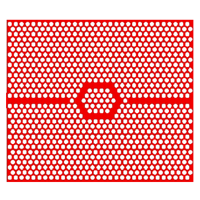
In this work, a two-dimensional photonic crystal ring resonator based temperature sensor is investigated. The device consists of a hexagonal array of air holes surrounded by the base material of germanium (Ge). The sensing mechanism is based on the shifting of transmission peak with refractive index changes in Ge induced by variation of temperature. Simulation results are obtained using finite difference time domain method (FDTD). The photonic band gap is studied by plane wave expansion method (PWE). The sensor has high sensitivity of 270 pm/K and high quality factor of 2028.86 with` wide range of temperature detection between 300 K to 800 K. The size of the structure is 112.91 (µm)2 and appropriate for sensing applications in nanotechnology.
References
E. Yablonovitch, “Inhibited spontaneous emission in solid-state physics and electronics,” Phys. Rev. Lett., vol. 58, pp. 2059–2062, 20 May 1987. https://doi.org/10.1103/PhysRevLett.58.2059.
S. John, “Strong localization of photons in certain disordered dielectric superlattices,” Phys. Rev. Lett., vol. 58, pp. 2486–2489, 23 Jun. 1987. https://doi.org/10.1103/PhysRevLett.58.2486.
B. Suthar, V. Kumar, A. Kumar, K. S. Singh, and A. Bhargava, “Thermal expansion of photonic band gap for one dimensional photonic crystal,” Progress In Electromagnetics Research Letters, vol. 32, pp. 81–90, 2012. https://doi.org/10.2528/pierl12041906.
A. Kumar, V. Kumar, B. Suthar, A. Bhargava, K. S. Singh, and S. P. Ojha, “Wide range temperature sensors based on one-dimensional photonic crystal with a single defect,” International Journal of Microwave Science and Technology, vol. 2012, pp. 1–5, Aug. 2012. https://doi.org/10.1155/2012/182793.
V. Kumar, B. Suthar, A. Kumar, K. Singh, and A. Bhargava, “The effect of temperature and angle of incidence on photonic band gap in a dispersive si-based one dimensional photonic crystal,” Physica B: Condensed Matter, vol. 416, pp. 106–109, May 2013. https://doi.org/10.1016/j.physb.2013.01.042.
B. Suthar and A. Bhargava, “Pressure sensor based on quantum well-structured photonic crystal,” Silicon, vol. 13, no. 6, pp. 1765–1768, Jul. 2020. https://doi.org/10.1007/s12633-020-00552-9.
K. V. Shanthi and S. Robinson, “Two-dimensional photonic crystal based sensor for pressure sensing,” Photonic Sensors, vol. 4, no. 3, pp. 248–253, Jul. 2014. https://doi.org/10.1007/s13320-014-0198-8.
T. Zouache, A. Hocini, A. Harhouz, and R. Mokhtari, “Design of pressure sensor based on two-dimensional photonic crystal,” Acta Physica Polonica A, vol. 131, no. 1, pp. 68–70, Jan. 2017. https://doi.org/10.12693/aphyspola.131.68.
X. Chen, L. Xia, and C. Li, “Surface plasmon resonance sensor based on a novel d-shaped photonic crystal fiber for low refractive index detection,” IEEE Photonics Journal, vol. 10, no. 1, pp. 1–9, 2018. https://doi.org/10.1109/JPHOT.2018.2790424.
Y. Zhao, D. Wu, and R.-Q. Lv, “Magnetic field sensor based on photonic crystal fiber taper coated with ferrofluid,” IEEE Photonics Technology Letters, vol. 27, no. 1, pp. 26–29, 2015. https://doi.org/10.1109/LPT.2014.2360531.
Y. Zhao, Y.-n. Zhang, R.-q. Lv, and J. Li, “Electric field sensor based on photonic crystal cavity with liquid crystal infiltration,” J. Lightwave Technol., vol. 35, no. 16, pp. 3440–3446, Aug. 2017. [Online]. Available: http://jlt.osa.org/abstract.cfm?URI=jlt-35-16-3440.
K. Deasy, K. N. Sediq, S. Brittle, et al., “A chemical sensor based on a photonic-crystal l3 nanocavity defined in a silicon-nitride membrane,” J. Mater. Chem. C, vol. 2, no. 41, pp. 8700–8706, Aug. 2014. https://doi.org/10.1039/c4tc01320d.
K. Lee and S. A. Asher, “Photonic crystal chemical sensors: pH and ionic strength,” Journal of the American Chemical Society, vol. 122, no. 39, pp. 9534–9537, Oct. 2000. https://doi.org/10.1021/ja002017n.
V. M. N. Passaro, B. Troia, M. L. Notte, and F. D. Leonardis, “Chemical sensors based on photonic structures, ”in Advances in Chemical Sensors, W.Wang, Ed., Rijeka: IntechOpen, 2012, ch. 5. https://doi.org/10.5772/30719.
Ankita, B. Suthar, and A. Bhargava, “Biosensor application of one-dimensional photonic crystal for malaria diagnosis,” Plasmonics, vol. 16, no. 1, pp. 59–63, Aug. 2020. https://doi.org/10.1007/s11468-020-01259-8.
Z. Rostamikafaki, “Optimization of the performance of biosensor based on photonic crystal resonant,” Universal Journal of Electrical and Electronic Engineering, vol. 6, no. 4, pp. 203–213, Oct. 2019. https://doi.org/10.13189/ujeee.2019.060403.
G. A. Rodriguez, P. Markov, A. P. Cartwright, et al., “Photonic crystal nanobeam biosensors based on porous silicon,” Optics Express, vol. 27, no. 7, p. 9536, Mar. 2019. https://doi.org/10.1364/oe.27.009536.
J. D. Joannopoulos, R. D. Meade, and J. N.Winn, Photonic crystals : molding the flow of light. Princeton: Princeton University Press, 1995, ISBN: 0691124566.
H.-w. Fu, H. Zhao, X.-g. Qiao, Y. Li, D.-z. Zhao, and Z. Yong, “Study on a novel photonic crystal temperature sensor,” Optoelectronics Letters, vol. 7, no. 6, pp. 419–422, Nov. 2011. https://doi.org/10.1007/s11801-011-0065-4.
A. Hocini and A. Harhouz, “Modeling and analysis of the temperature sensitivity in two-dimensional photonic crystal microcavity,” Journal of Nanophotonics, vol. 10, no. 1, p. 016 007, Feb. 2016. https://doi.org/10.1117/1.jnp.10.016007.
C. Mallika, I. Bahaddur, P. Srikanth, and P. Sharan, “Photonic crystal ring resonator structure for temperature measurement,” Optik, vol. 126, no. 20, pp. 2252–2255, Oct. 2015. https://doi.org/10.1016/j.ijleo.2015.05.123.
R. Rajasekar and S. Robinson, “Nano-pressure and temperature sensor based on hexagonal photonic crystal ring resonator,” Plasmonics, vol. 14, no. 1, pp. 3–15, May 2018. https://doi.org/10.1007/s11468-018-0771-x.
R. Zegadi, L. Ziet, and A. Zegadi, “Design of high sensitive temperature sensor based on two-dimensional photonic crystal,” Silicon, vol. 12, no. 9, pp. 2133–2139, Dec. 2019. https://doi.org/10.1007/s12633-019-00303-5.
F. Bounaas and A. Labbani, “High sensitivity temperature sensor based on photonic crystal resonant cavity,”Progress In Electromagnetics Research Letters, vol. 90, pp. 85–90, 2020. https://doi.org/10.2528/pierl20010204.
J. V. Malik, K. D. Jindal, V. Kumar, et al., “Effect of temperature on photonic band gaps in semiconductorbased one-dimensional photonic crystal,” Advances in Optical Technologies, vol. 2013, pp. 1–8, Aug. 2013. https://doi.org/10.1155/2013/798087.
K. M. Ho, C. T. Chan, and C. M. Soukoulis, “Existence of a photonic gap in periodic dielectric structures,”Physical Review Letters, vol. 65, no. 25, pp. 3152–3155, Dec. 1990. https://doi.org/10.1103/physrevlett.65.3152.
B. Suthar and A. Bhargava, “Channel drop filter application of 2-d photonic crystal,” AIP Conference Proceedings, vol. 1324, no. 1, pp. 419–421, 2010. https://doi.org/10.1063/1.3526249.
H. H. Li, “Refractive index of silicon and germanium and its wavelength and temperature derivatives,” Journal of Physical and Chemical Reference Data, vol. 9, no. 3, pp. 561–658, Jul. 1980. https://doi.org/10.1063/1.555624.
Y.-n. Zhang, Y. Zhao, and R.-q. Lv, “A review for optical sensors based on photonic crystal cavities,” Sensors and Actuators A: Physical, vol. 233, pp. 374–389, Sep. 2015. https://doi.org/10.1016/j.sna.2015.07.025.
Downloads
Published
How to Cite
Issue
Section
License
Copyright (c) 2021 Sapna Dinodiya, B. Suthar, A. Bhargava

This work is licensed under a Creative Commons Attribution-NonCommercial 4.0 International License.
By submitting documents to Jurnal OptoElektronik, the authors agree to the followings:
1. Articles are published under a Creative Commons CC BY-NC 4.0 license that allows third parties to read, download, copy and share their work provided proper acknowledgement are given.
2. The authors retain copyright and grant Jurnal OptoElektronik rights of first publication.
3. The authors are permitted and encouraged to share their work online (e.g., in institutional repositories or on their website)
4. The authors verifies that the submission has not been previously published, nor is it before another journal for consideration. If submitting an article for resubmission, the submitting author will need to notify the editor through the Comments for the Editor section in the submission process.
5. The authors are responsible to secure all necessary copyright permissions for the use of 3rd-party materials in their manuscript.
6. The author declares that this is their original work and has been written by the stated authors.