Performance Comparison of Thiophene Derivative Films for SPR-Based Creatinine Detection
DOI:
https://doi.org/10.53655/joe.m6577rKeywords:
Creatinine, SPR, ThiopheneAbstract
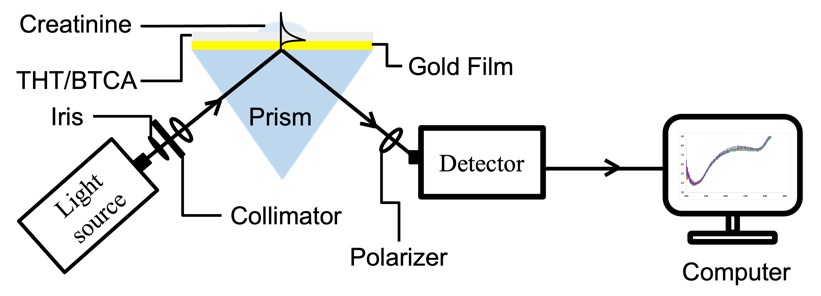
This study presents a comparative SPR analysis of tetrahydrothiophene (THT) and benzo[b]thiophene-2-carboxaldehyde (BTCA) as sensing layers for creatinine detection. Using an SPR setup, both materials exhibited concentration-dependent spectral shifts. The BTCA-based sensor demonstrated higher sensitivity (3.3557 nm/(mg/dL)), better linearity (R² = 0.9636), and lower detection limits than THT, attributed to stronger molecular interactions, including hydrogen bonding and dipole-dipole effects. These results confirm BTCA's superior plasmonic response, supporting its potential as a label-free sensing material for creatinine detection in clinical diagnostics.
References
A.N. Boa, P.R. Jenkins, C. Li, J. Wang, Benzyl 2,2,2-Trichloroacetimidate, Encyclopedia of Reagents for Organic Synthesis (2011). https://doi.org/10.1002/047084289X.RB076.
H.S. Biswal, Hydrogen Bonds Involving Sulfur: New Insights from ab Initio Calculations and Gas Phase Laser Spectroscopy, Challenges and Advances in Computational Chemistry and Physics 19 (2015) 15–45. https://doi.org/10.1007/978-3-319-14163-3_2.
X. Chen, G. Wang, X. Zeng, W. Li, M. Zhou, Unveiling the Role of Water on π-π Stacking Through Microwave Spectroscopy of (Thiophene)2-(Water)1-2 Clusters, J Am Chem Soc 146 (2024). https://doi.org/10.1021/jacs.3c10887.
Downloads
Published
How to Cite
Issue
Section
License
Copyright (c) 2025 Nur Afifah Ahmad Nazri, Nur Hidayah Azeman, Nur Izzah Zakaria, Muhammad Asif Ahmad Khusaini, Mohd Hafiz Abu Bakar, Tengku hasnan Tengku Abdul Aziz, Ahmad Ashrif A Bakar, Ahmad Rifqi Md Zain

This work is licensed under a Creative Commons Attribution-NonCommercial 4.0 International License.
By submitting documents to Jurnal OptoElektronik, the authors agree to the followings:
1. Articles are published under a Creative Commons CC BY-NC 4.0 license that allows third parties to read, download, copy and share their work provided proper acknowledgement are given.
2. The authors retain copyright and grant Jurnal OptoElektronik rights of first publication.
3. The authors are permitted and encouraged to share their work online (e.g., in institutional repositories or on their website)
4. The authors verifies that the submission has not been previously published, nor is it before another journal for consideration. If submitting an article for resubmission, the submitting author will need to notify the editor through the Comments for the Editor section in the submission process.
5. The authors are responsible to secure all necessary copyright permissions for the use of 3rd-party materials in their manuscript.
6. The author declares that this is their original work and has been written by the stated authors.