Effect of MoS2 coated on tapered optical fiber for humidity sensor
DOI:
https://doi.org/10.53655/joe.y8940mKeywords:
Tapered Optical Fiber, Hear and Pull Method, MoS2 Coated, Humidity SensorAbstract
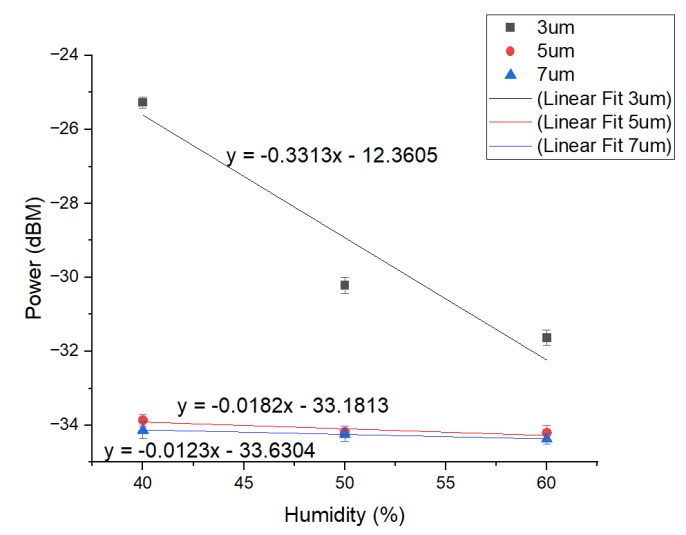
This study investigates the influence of tapered optical fiber diameter and MoS₂ concentration on the sensitivity of optical humidity sensors fabricated using the heat-and-pull method. Optical fibers with tapered diameters of 3 µm, 5 µm, and 7 µm were analyzed under varying humidity levels (40%, 50%, and 60%). Additionally, the effect of different MoS₂ concentrations 2 µl, and 4 µl coated on the fiber surface was examined for each diameter. Experimental results demonstrate that smaller fiber diameters yield significantly higher sensitivity, with the 3 µm fiber showing the greatest power response at all humidity levels-up to 35.07% more sensitivity at 40% humidity compared to 7 µm fibers. Furthermore, increasing MoS₂ concentration enhances the sensor response across all diameters, with the 4 µl concentration consistently delivering the highest power output. For example, at 40% humidity, a 4 µL concentration on a 7 µm fiber produced an 18.89% increase in sensitivity compared to an uncoated fiber. These findings highlight that both reduced fiber diameter and increased MoS₂ concentration significantly improve the sensitivity of optical humidity sensors, offering a promising approach for developing high-performance environmental sensing devices.
References
R. Hui and ScienceDirect, Introduction to fiber-optic communications. London, United Kingdom ; San Diego, CA, United States: Academic Press (in English), 2020.
S. Addanki, I. S. Amiri, and P. Yupapin, "Review of optical fibers-introduction and applications in fiber lasers," Results in Physics, vol. 10, pp. 743-750, 2018, doi: 10.1016/j.rinp.2018.07.028.
T. Liu, J. Jiang, K. Liu, and S. Wang, Optical fiber sensing technologies: principles, techniques and applications. Weinheim, Germany: Wiley-VCH (in English), 2022.
H. Wang, L. Jiang, and P. Xiang, "Improving the durability of the optical fiber sensor based on strain transfer analysis," Optical Fiber Technology, vol. 42, pp. 97-104, 2018, doi: 10.1016/j.yofte.2018.02.004.
Downloads
Published
How to Cite
Issue
Section
License
Copyright (c) 2025 Muhamad Afiq Aiman Mazlan, Norazida Ali, Aziati Binti Awang, Naimah Mat Isa, Norhafizah Burham

This work is licensed under a Creative Commons Attribution-NonCommercial 4.0 International License.
By submitting documents to Jurnal OptoElektronik, the authors agree to the followings:
1. Articles are published under a Creative Commons CC BY-NC 4.0 license that allows third parties to read, download, copy and share their work provided proper acknowledgement are given.
2. The authors retain copyright and grant Jurnal OptoElektronik rights of first publication.
3. The authors are permitted and encouraged to share their work online (e.g., in institutional repositories or on their website)
4. The authors verifies that the submission has not been previously published, nor is it before another journal for consideration. If submitting an article for resubmission, the submitting author will need to notify the editor through the Comments for the Editor section in the submission process.
5. The authors are responsible to secure all necessary copyright permissions for the use of 3rd-party materials in their manuscript.
6. The author declares that this is their original work and has been written by the stated authors.