Enhancing Bandwidth and Efficiency in GaN LEDs for VLC Systems
DOI:
https://doi.org/10.53655/joe.v3332mKeywords:
LED, VLC, Rare-Earth Doping, Europium (Eu3 ), GaN-LEDAbstract
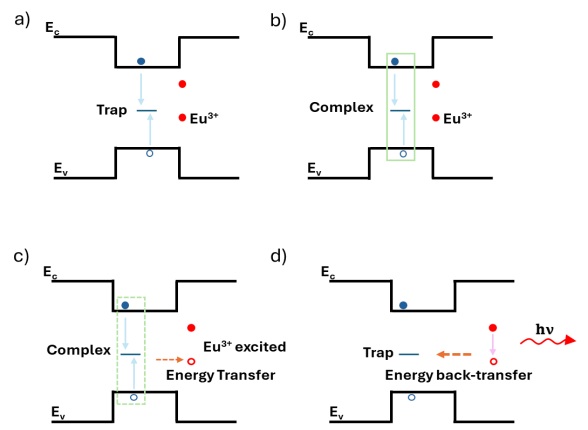
Gallium nitride (GaN) light-emitting diodes (LEDs) are essential for visible light communication (VLC), enabling high-speed data transmission and energy-efficient lighting. However, c-plane GaN LEDs face limitations due to polarization fields and the quantum-confined Stark effect (QCSE), restricting bandwidth and data rates. Advances in semi-polar and non-polar GaN structures have enhanced bandwidth, supporting gigabit-per-second VLC performance. Optimizing the active region through quantum well thinning and hybrid quantum dot integration further boosts modulation speeds. Additionally, Europium (Eu³⁺) doping provides high-color-purity red emission and faster recombination, improving bandwidth and reducing efficiency droop. This review highlights these innovations for high-speed VLC systems.
References
F. Xu et al., “High Bandwidth Semi-Polar InGaN/GaN Micro-LEDsWith Low Current Injection for Visible Light Communication,” IEEE Photonics Journal, vol. 15, no. 1, pp. 1–4, Feb. 2023, ISSN: 1943-0647. DOI:10.1109/jphot.2023.3235108
A. Rashidi, M. Monavarian, A. Aragon, A. Rishinaramangalam, and D. Feezell, “Nonpolar m-Plane InGaN/GaN Micro-Scale Light-Emitting Diode With 1.5 GHz Modulation Bandwidth,” IEEE Electron Device Letters, vol. 39, no. 4, pp. 520–523, Apr. 2018, ISSN: 1558-0563. DOI: 10.1109/led.2018.2803082
P. Yin, T. Zhi, T. Tao, and X. Liu, “Study on Modulation Bandwidth of GaN-Based Micro-Light-Emitting Diodes by Adjusting Quantum Well Structure,” Nanomaterials, vol. 12, no. 21, p. 3818, Oct. 2022, ISSN:2079-4991. DOI: 10.3390/nano12213818
S. Zhu et al., “Influence of quantum confined Stark effect and carrier localization effect on modulation bandwidth for GaN-based LEDs,” Applied Physics Letters, vol. 111, no. 17, Oct. 2017, ISSN: 1077-3118. DOI:10.1063/1.4993230
S. Cai, D. Wang, N. Zeng, K. Li, Q. Wu, and Y. Yin, “Influence of multiple quantum well number on modulation bandwidth of InGaN/GaN light-emitting diodes,” Journal of Optics, vol. 50, no. 1, pp. 83–89, Jan. 2021, ISSN: 0974-6900. DOI: 10.1007/s12596-020-00666-8
B. L. Murillo-Borjas, X. Li, and Q. Gu, “High-speed nanoLEDs for chip-scale communication,” Nano Communication Networks, vol. 30, p. 100 376, Dec. 2021, ISSN: 1878-7789. DOI: 10.1016/j.nancom.2021.100376
J. Yu et al., “Improving the internal quantum efficiency of green InGaN quantum dots through coupled InGaN/GaN quantum well and quantum dot structure,” Applied Physics Express, vol. 8, no. 9, p. 094 001, Aug. 2015, ISSN: 1882-0786. DOI: 10.7567/apex.8.094001
J. Rodrigues et al., “Rare earth co-doping nitride layers for visible light,” Materials Chemistry and Physics, vol. 134, no. 2–3, pp. 716–720, Jun. 2012, ISSN: 0254-0584. DOI: 10.1016/j.matchemphys.2012.03.056
J. Wang, “Optical and Electrical Study of the Rare Earth Doped III-nitride Semiconductor Materials,” Ph.D. dissertation, Ohio University, 2016.
F. Murakami, A. Takeo, B. Mitchell, V. Dierolf, Y. Fujiwara, and M. Tonouchi, “Enhanced luminescence efficiency in Eu-doped GaN superlattice structures revealed by terahertz emission spectroscopy,” Communications Materials, vol. 4, no. 1, Nov. 2023, ISSN: 2662-4443. DOI: 10.1038/s43246-023-00428-6
I. E. Fragkos, C.-K. Tan, V. Dierolf, Y. Fujiwara, and N. Tansu, “Pathway Towards High-Efficiency Eudoped GaN Light-Emitting Diodes,” Scientific Reports, vol. 7, no. 1, Nov. 2017, ISSN: 2045-2322. DOI:10.1038/s41598-017-15302-y
Downloads
Published
How to Cite
Issue
Section
License
Copyright (c) 2025 Norhanis Aida Mohd Nor, Wan Nur Amierha Wan Ibrahim

This work is licensed under a Creative Commons Attribution-NonCommercial 4.0 International License.
By submitting documents to Jurnal OptoElektronik, the authors agree to the followings:
1. Articles are published under a Creative Commons CC BY-NC 4.0 license that allows third parties to read, download, copy and share their work provided proper acknowledgement are given.
2. The authors retain copyright and grant Jurnal OptoElektronik rights of first publication.
3. The authors are permitted and encouraged to share their work online (e.g., in institutional repositories or on their website)
4. The authors verifies that the submission has not been previously published, nor is it before another journal for consideration. If submitting an article for resubmission, the submitting author will need to notify the editor through the Comments for the Editor section in the submission process.
5. The authors are responsible to secure all necessary copyright permissions for the use of 3rd-party materials in their manuscript.
6. The author declares that this is their original work and has been written by the stated authors.