Signal to Noise Ratio Performance Analysis for Vibration Detection Using Phase Sensitive OTDR in Distributed Acoustic Sensing
DOI:
https://doi.org/10.53655/joe.y2300jKeywords:
Optical time domain reflectometry, signal to noise ratio, distributed acoustic sensingAbstract
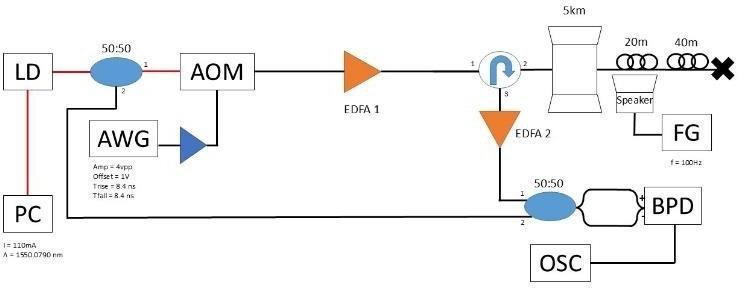
Phase-sensitive optical time-domain reflectometry (Φ-OTDR) has emerged as a powerful technique for distributed acoustic sensing (DAS) in a wide range of applications, including perimeter security. The signal-to-noise ratio (SNR) is a critical parameter in determining the sensitivity and reliability of vibration detection in these systems. In this paper, we present a detailed analysis of SNR performance in Φ-OTDR-based DAS systems. We investigate the influence of key system parameters such as optical pulse width, vibration frequencies and spatial resolution on the SNR value. A DAS setup is developed to evaluate how these parameters affect the backscattered signal and noise characteristics over pulse widths and vibration frequencies. Our results show that SNR increases exponentially with optical pulse widths, but it degrades the spatial resolution value. The findings provide practical insights into the phase information in the development of a more efficient and sensitive DAS system. This work contributes to the growing understanding of SNR limitations and enhancement strategies in distributed fiber optic sensing.
References
Fernández-Ruiz, M. R., Soto, M. A., Williams, E. F., Martin-Lopez, S., Zhan, Z., Gonzalez-Herraez, M., & Martins, H. F. (2020). Distributed acoustic sensing for seismic activity monitoring. In APL Photonics (Vol. 5, Issue 3). AIP Publishing. https://doi.org/10.1063/1.5139602
Goldman, R., Agmon, A., & Nazarathy, M. (2013). Direct detection and coherent optical time-domain reflectometry with golay complementary codes. Journal of Lightwave Technology, 31(13), 2207–2222. https://doi.org/10.1109/JLT.2013.2264273
Li, W., Bao, X., Li, Y., & Chen, L. (2008). Differential pulse-width pair BOTDA for high spatial resolution sensing.
Naeem, K., Kim, B. H., Yoon, D. J., & Kwon, I. B. (2021). Enhancing detection performance of the phase‐sensitive otdr based distributed vibration sensor using weighted singular value decomposition. Applied Sciences (Switzerland), 11(4), 1–12. https://doi.org/10.3390/app11041928
Wang, Z., Zhang, L., Wang, S., Xue, N., Peng, F., Fan, M., Sun, W., Qian, X., Rao, J., & Rao, Y. (2016). Coherent Φ-OTDR based on I/Q demodulation and homodyne detection. Optics Express, 24(2), 853. https://doi.org/10.1364/oe.24.000853
Downloads
Published
How to Cite
Issue
Section
License
Copyright (c) 2025 Muhsin Muhsin, Hafiz Zulhazmi Jabidin, Ain Nabihah Mohammad Rihan, Wan Muhammad Noor Haekal W Mamat, Mohd Saiful Dzulkefly Zan

This work is licensed under a Creative Commons Attribution-NonCommercial 4.0 International License.
By submitting documents to Jurnal OptoElektronik, the authors agree to the followings:
1. Articles are published under a Creative Commons CC BY-NC 4.0 license that allows third parties to read, download, copy and share their work provided proper acknowledgement are given.
2. The authors retain copyright and grant Jurnal OptoElektronik rights of first publication.
3. The authors are permitted and encouraged to share their work online (e.g., in institutional repositories or on their website)
4. The authors verifies that the submission has not been previously published, nor is it before another journal for consideration. If submitting an article for resubmission, the submitting author will need to notify the editor through the Comments for the Editor section in the submission process.
5. The authors are responsible to secure all necessary copyright permissions for the use of 3rd-party materials in their manuscript.
6. The author declares that this is their original work and has been written by the stated authors.