Comparative Study on Carbon Dots and Carboxyl-Carbon Dots - LSPR for Creatinine Detection
DOI:
https://doi.org/10.53655/joe.t7402mKeywords:
Carbon dots, Carboxyl carbon dots, SPR, Creatinine, Optical sensorAbstract
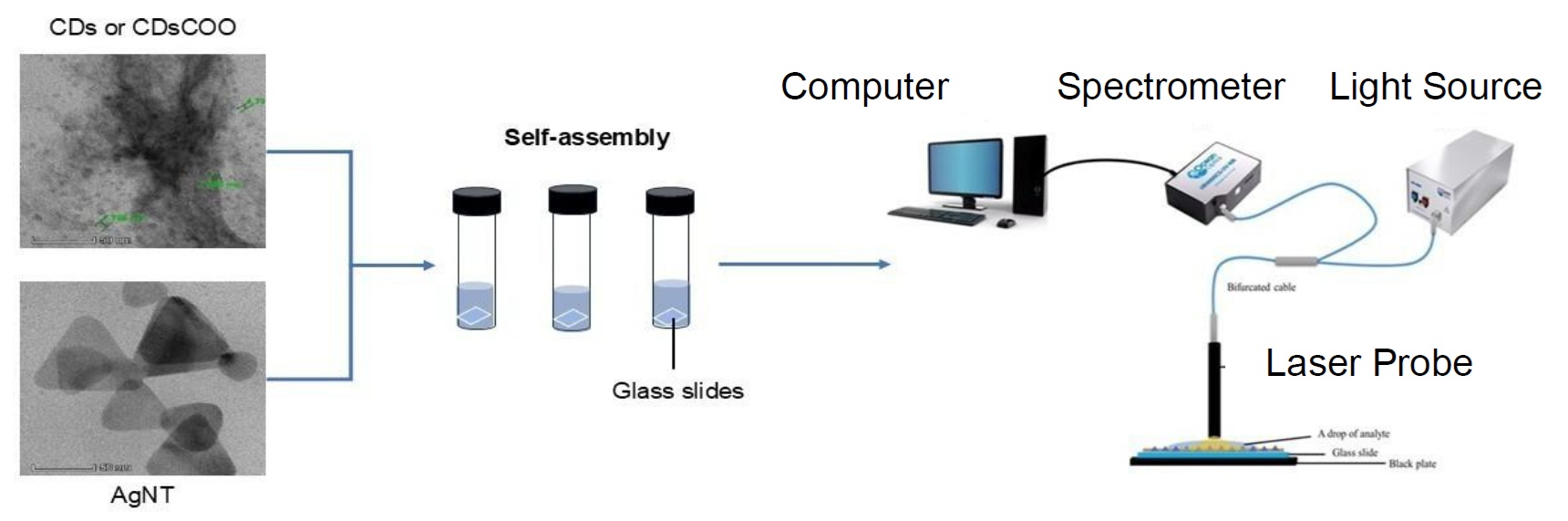
The detection of creatinine, a crucial biomarker for kidney function, has attracted significant attention due to the need for rapid and sensitive detection. In this study, we report a comparative analysis of Carbon Dots (CDs) and Carboxyl-Carbon Dots (CDsCOO) for developing a fluorescent-based creatinine sensor. Both carbon dots were synthesized via a hydrothermal approach, with surface modification introduced to generate carboxyl functional groups in CDsCOO. Creatinine sensing performance was evaluated based on the fluorescence quenching response, calibration curve linearity, sensitivity, and limit of detection (LOD). The effectiveness of this material was evaluated at concentrations ranging from 0 to 0.6 mg/dL. The CDsCOO demonstrated superior performance with enhanced sensitivity and a lower LOD than unmodified CDs, achieving a LOD of approximately [0.05 mg/dL & 0.28 mg/dL] and a sensitivity of [20.123 ndL/g & 3.696 ndL/g]. This work highlights the potential of CDsCOO as a promising platform for efficient and selective creatinine detection.
References
B. P. Nanda, P. Rani, P. Paul, Aman, S. S. Ganti, and R. Bhatia, “Recent trends and impact of localized surface plasmon resonance (lspr) and surface-enhanced raman spectroscopy (sers) in modern analysis,” Journal of Pharmaceutical Analysis, vol. 14, no. 11, p. 100 959, Nov. 2024, ISSN: 2095-1779. DOI:10.1016/j.jpha.2024.02.013
A. S. Masran et al., “Sensitivity improvement of creatinine detection based on functionalized carbon dots and silver nanotriangular localized surface plasmon resonance,” Plasmonics, Jan. 2025, ISSN: 1557-1963. DOI:10.1007/s11468-024-02739-x
N. H. Azeman et al., “Carboxymethyl chitosan/graphene oxide/silver nanotriangles nanohybrid as the sensing materials for the enhancement of ammonia localized surface plasmon resonance sensor,” Optics
Downloads
Published
How to Cite
Issue
Section
License
Copyright (c) 2025 Athiyah Sakinah Masran, Nur Hidayah Azeman, Nur Afifah Ahmad Nazri, Azween Hadiera Hishamuddin, Mohd Hafiz Abu Bakar, Muhammad Qayyum Othman, Rozita Sulaiman, Ahmad Ashrif A Bakar

This work is licensed under a Creative Commons Attribution-NonCommercial 4.0 International License.
By submitting documents to Jurnal OptoElektronik, the authors agree to the followings:
1. Articles are published under a Creative Commons CC BY-NC 4.0 license that allows third parties to read, download, copy and share their work provided proper acknowledgement are given.
2. The authors retain copyright and grant Jurnal OptoElektronik rights of first publication.
3. The authors are permitted and encouraged to share their work online (e.g., in institutional repositories or on their website)
4. The authors verifies that the submission has not been previously published, nor is it before another journal for consideration. If submitting an article for resubmission, the submitting author will need to notify the editor through the Comments for the Editor section in the submission process.
5. The authors are responsible to secure all necessary copyright permissions for the use of 3rd-party materials in their manuscript.
6. The author declares that this is their original work and has been written by the stated authors.