Surface Plasmon Resonance Polymer Optical Fiber Sensor for Enhanced Oxygen Detection with PdTFPP-Based
DOI:
https://doi.org/10.53655/joe.c3450tKeywords:
Polymer optical fiber, Surface plasmon resonance, Fluorescence dye, Oxygen sensing, PalladiumAbstract
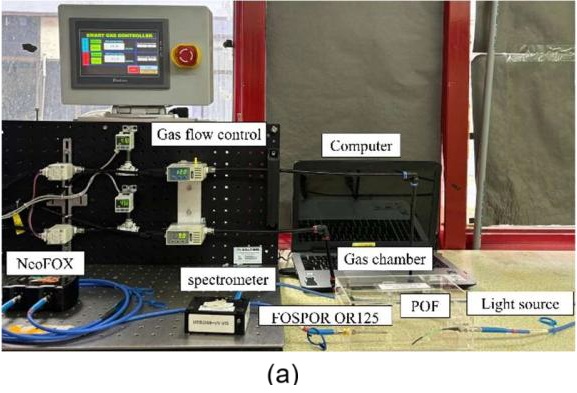
This study presents an enhanced oxygen detection method combining fluorescence sensing with surface plasmon resonance (SPR) using a multimode polymer optical fiber (POF). The POF is coated with a silver layer for SPR and the palladium-based dye PdTFPP, known for its high oxygen sensitivity. PdTFPP alone showed an emission peak at 668.62 nm, with intensity decreasing as oxygen concentration increased. The SPR-enhanced sensor showed a sensitivity of 0.1045 compared to 0.0944 for PdTFPP alone, demonstrating improved performance.
References
P. V. Melnikov et al., “Optical oxygen sensing and clark electrode: Face-to-face in a biosensor case study,” Sensors, vol. 22, no. 19, p. 7626, Oct. 2022, ISSN: 1424-8220. DOI: 10.3390/s22197626
M. Luo and Q.Wang, “A reflective optical fiber spr sensor with surface modified hemoglobin for dissolved oxygen detection,” Alexandria Engineering Journal, vol. 60, no. 4, pp. 4115–4120, Aug. 2021, ISSN: 1110-0168. DOI: 10.1016/j.aej.2020.12.041
C.-S. Chu, “Optical fiber oxygen sensor based on pd(ii) complex embedded in sol–gel matrix,” Journal of Luminescence, vol. 135, pp. 5–9, Mar. 2013, ISSN: 0022-2313. DOI: 10.1016/j.jlumin.2012.10.006
A. R. Abdul Rashid et al., “Chemical tapering of polymer optical fiber,” EPJ Web of Conferences, vol. 162, M. H. A. Wahid, Ed., p. 01 015, 2017, ISSN: 2100-014X. DOI: 10.1051/epjconf/201716201015
Y. Zhao, H. Zhang, Q. Jin, D. Jia, and T. Liu, “Ratiometric optical fiber dissolved oxygen sensor based on fluorescence quenching principle,” Sensors, vol. 22, no. 13, p. 4811, Jun. 2022, ISSN: 1424-8220. DOI:10.3390/s22134811
G. Janith et al., “Advances in surface plasmon resonance biosensors for medical diagnostics: An overview of recent developments and techniques,” Journal of Pharmaceutical and Biomedical Analysis Open, vol. 2, p. 100 019, Dec. 2023, ISSN: 2949-771X. DOI: 10.1016/j.jpbao.2023.100019
Downloads
Published
How to Cite
Issue
Section
License
Copyright (c) 2025 Azween Hadiera Hishamuddin, Ahmad Sabirin Zoolfakar, Mohd Hafiz Abu Bakar, Fairuz Abdullah, Nur Hidayah Azeman, Ahmad Ashrif A Bakar, Maizatul Zolkapli

This work is licensed under a Creative Commons Attribution-NonCommercial 4.0 International License.
By submitting documents to Jurnal OptoElektronik, the authors agree to the followings:
1. Articles are published under a Creative Commons CC BY-NC 4.0 license that allows third parties to read, download, copy and share their work provided proper acknowledgement are given.
2. The authors retain copyright and grant Jurnal OptoElektronik rights of first publication.
3. The authors are permitted and encouraged to share their work online (e.g., in institutional repositories or on their website)
4. The authors verifies that the submission has not been previously published, nor is it before another journal for consideration. If submitting an article for resubmission, the submitting author will need to notify the editor through the Comments for the Editor section in the submission process.
5. The authors are responsible to secure all necessary copyright permissions for the use of 3rd-party materials in their manuscript.
6. The author declares that this is their original work and has been written by the stated authors.